ControlsBrain
Reducing carbon footprint is a common goal and target in operating and managing modern buildings. One of the critical elements to achieving this goal is efficiently using the Building Automation System. The Building Automation system went through different development stages, from a standalone controls system to a connected and integrated one leveraging AI and machine learning technology to provide insights and analytics and shift from reactive to pre-emptive operation leading to more efficient operation and contributing to the reduction of energy consumption and carbon footprint of the buildings.
Throughout the evolution journey, the building automation system operators who manage the system, attend to resolve problems, and modify operations intended to match the building efficiency expectations, should have been given the relevant importance. Their expertise was not considered at the heart of the evolving building automation journey.
The concept of cognitive buildings is still in the innovation phase, and it is challenging to transition to it for optimum operational efficiency. I thought about exploiting the operators' collective Knowledge and experience proposing a generic framework for a hybrid cognitive AI model that embeds this Knowledge as an essential element to accelerate the development, I name the concept ControlsBrain.
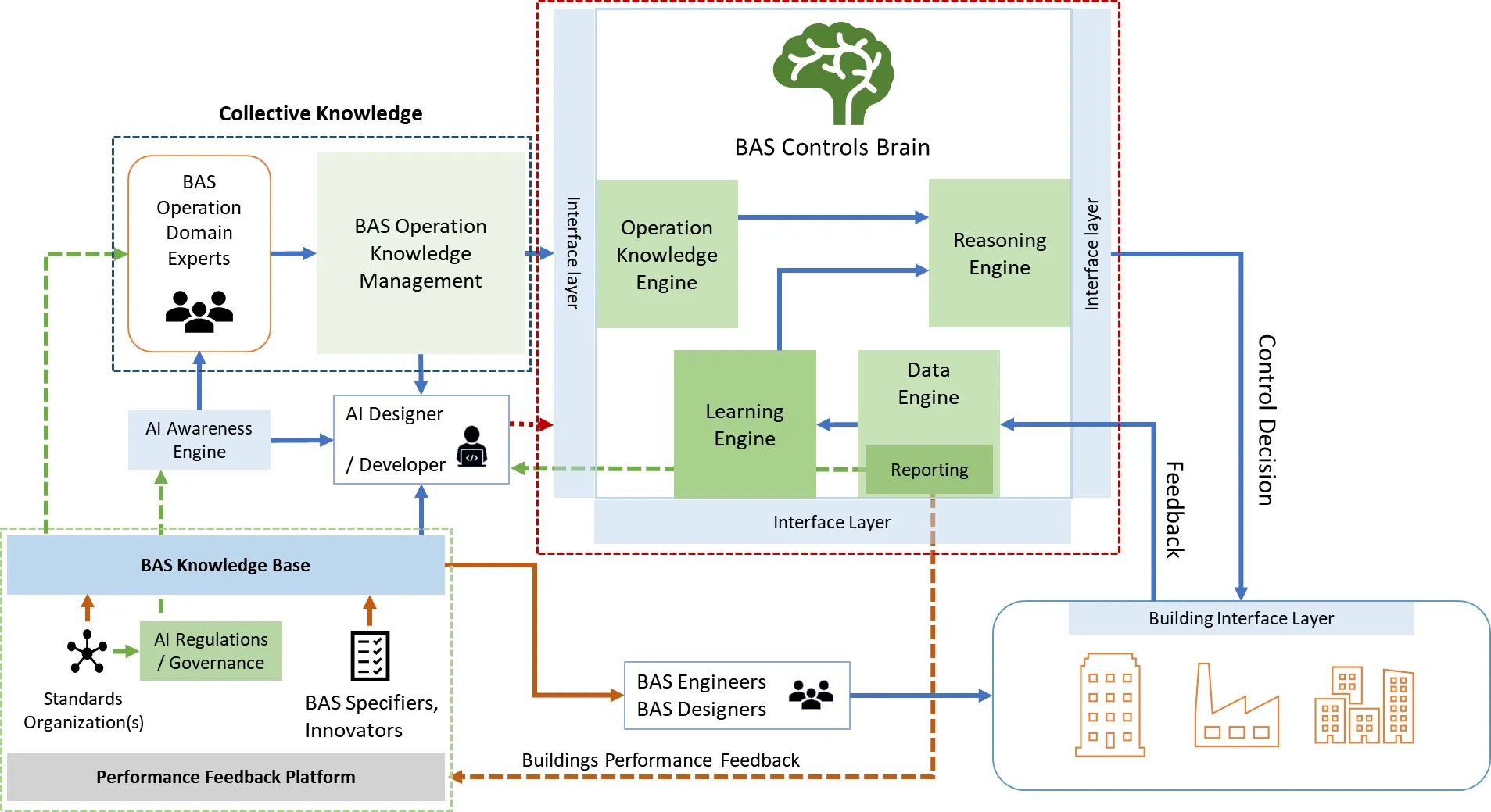
A brief description of each of the concept components:
BAS Knowledge Base
It serves as a library of information about BAS, systems schematics, structures, components, and operation (i.e., Air handling unit, water pumps, boilers, chillers, fans), incorporating the latest standards that rule its installation and usage, and operation. The knowledge base also includes the specifiers' requirements for best practices that incorporate the laws of physics and building regulations (type and purpose of the building). The information is shared with BAS designers and Installers to make sure the implemented designers adhere to the latest requirements, most notably the Interoperability of the system and its readiness to provide the flow of data (control and monitor) up and down the stream and the proper representation of its equipment, and subsystems at the field level.
AI Regulations / Governance
Generated by a standards organization and regulatory policymakers, a public repository saves and manages all the standards, rules, BAS & AI governing regulations, and benchmark indicators to analyze the operational performance of the buildings.
Performance Feedback
An open platform that manages and presents feedback about the overall system performance related to essential indicators (i.e., energy consumption, operational costs, carbon footprint).
AI Awareness Engine
Used by operators and designers to raise their awareness about AI usage within the BAS industry and its cognitive qualities and capabilities, support their decision-making process, and effectively facilitate use and collaboration with the BAS AI system. The engine is fed with data generated by standards organizations. It adds to the technical expertise of the BAS operators and is a guideline for AI model developers.
BAS Operation Knowledge Management
The structure will connect the expert domain knowledge with a knowledge repository used by the Controls Brain model, facilitating the experience part of the virtual brain decision-making process. The AI developer also uses Knowledge to overcome the narrow experience limitation needed to build the cognitive model representing the operators.
Interface Layer
The Interface layer represents the unified, interoperable layer for communications with all related entities. It allows transmission of the command and feedback data between the Controls Brain and the BAS installed in Buildings.
Operation Knowledge Engine
Acts as an inference engine module built as part of the controls brain AI model to logically interpret the BAS operation Knowledge and provide its output to the reasoning engine module.
Learning Engine
The module implements the machine learning algorithms part of the Controls Brain process to interpret data and feedback collected from buildings. Machine learning algorithms can be any or a combination of well-known AI algorithms serving the BAS industry. The system will learn and profile serviced facilities and provide its reasoning engine output.
Data Engine
It gathers and processes data feedback and feeds the structured findings to the learning engine. The engine will deal with live data streams covering the overall operational status of the BAS system in each building, quarried through the interface layer.
Reasoning Engine
It is an AI module that can think and act more like humans, combining the learned Knowledge from controlled buildings and the BAS operation domain expert collective Knowledge. It provides the cognitive capabilities for the Controls Brain model.
The reasoning engine will perform the core tasks:
- Perceive and interpret the information learned from buildings and sites,
- Process the Knowledge to solve operational problems at hand (formulate commands),
- Mimic Operators deal with possibilities and overcoming limitations (creativity, adaptivity, autonomy, and awareness),
- Navigate through biases inherited from the BAS operation domain experts during the training process,
- Dealing with the BAS goal functions by evaluating actions concerning costs, energy efficiency, and occupant comfort.
While collective Knowledge is a cornerstone in the suggested framework, the method to acquire Knowledge from domain experts is still to be studied. There is much work to be done on the concept, including finding the proper techniques that will capture and profile the individual operators' Knowledge that will collectively be integrated into the module and suggest a modification to the proposed model. (i.e., capturing the Knowledge from each person directly at a project by profiling the decisions, dealings, biases, methods of handling the operation, and to what level each profile is efficiently operating the BAS).
There are also other challenges, including open collaboration. The commercial competition in the industry is high. Those who achieve the highest optimization and operational efficiency returns would win the market. Unifying the efforts toward reducing the carbon footprint in buildings where the Building Automation System plays an integral part becomes a challenge to overcome.
Controls Brain concept integrating the Collective Knowledge at its heart might be one of the tens of solutions that require building and testing. Measuring the effect of Collective Knowledge and its contribution to the overall performance of the proposed concept depends on the outcome and BAS performance at facilities. It is a critical metric that shows the practical result in cost savings, energy efficiency, comfort, and safety. While using cognitive-like AI models already showed results in energy efficiency, incorporating reasoning based on operators' preferences and collective experience is expected to extend this efficiency by allowing collaborative decision-making and addressing complex issues if the challenges for such integration are addressed.
I will share some extras on Autonomous Systems based on various pieces of research in another post. 😉
Thank you for being here and reading this piece.