Evaluating Building Automation Systems Toward Intelligent Buildings
One of the main enablers to achieving a reduction of carbon footprint in operating and managing modern buildings is efficiently using the Building Automation System. The Building Automation went through different stages, from a standalone control system to a connected and integrated one. There is a promise that the emerging technologies from AI and Machine Learning, Cloud Computing, and the Internet of Things, to Digital Twin would provide advanced operational efficiency through unlocking advanced insights, analytics, and the shift from reactive to pre-emptive operations leading to operating Buildings intelligently contributing to the reduction of energy consumption, the carbon footprint, and achieving occupants' health and safety.
The concept of applying new technologies to Building Automation systems is not new. Manufacturers continue to innovate, upgrade, enhance, and fine-tune their products to meet market requirements, regulations, and evolving standards. When it comes to building owners, it is always a challenge to decide on selecting the best Building Automation system that enables Intelligence and meets other requirements towards reducing operational costs and ensuring sustainability and efficiency goals are achieved.
I developed an evaluation framework to evaluate Building Automation systems and their contribution toward enabling Intelligent Buildings. A framework that would allow various stakeholders to conduct an initial assessment for Building Automation systems from single or multiple manufacturers, in line with Intelligent Buildings requirements.
BAS Evaluation Framework Concept Design
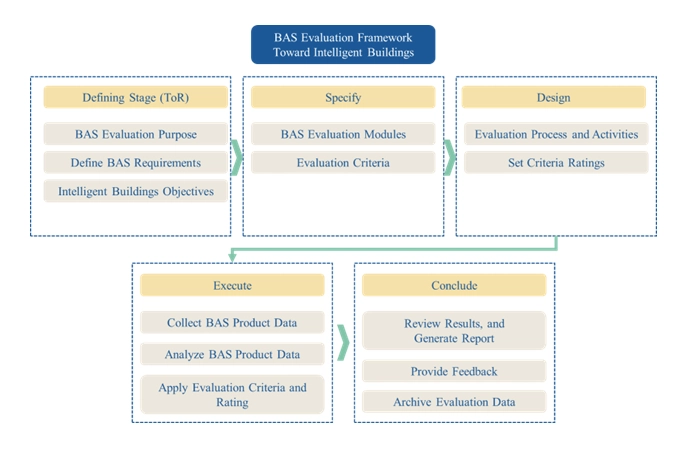
The framework evaluates the building automation system product and its usage as an enabler for intelligent buildings. Designing buildings is a complex procedure with many standards and regulations involved. The framework does not touch on deep details but evaluates the built BAS features and components that enable intelligent building functionality. The framework could be used as the owners' pre-selection approach for the BAS product or a benchmark to compare various BAS products.
The framework introduces evaluation criteria modules related to enabling technologies, regulations, and BAS architectures. The criteria modules cover the following:
- Operational efficiency and reduced energy consumption
- Openness and Interoperability of the BAS Components
- Occupant Comfort and Security
- Enabling Technologies: Cloud, IoT, AI and ML, Digital Twin
- Compliance with standards and regulations of future intelligent building
Evaluation Objectives
We can summarize the objectives behind evaluating the BAS system as an enabler for intelligent buildings as follows:
- Enable reduction of Energy Consumption
- Achieve Occupancy Comfort with enhanced analytics
- Improves Security for occupants
- Automating building operation
- Improve Maintenance Activities
- Improve Fault detection and diagnoses
- Support Achieving sustainable goals of the building owner(s)
- Compliance with Security, safety, and privacy standards
Evaluation Modules and Associated Criteria
The following modules and their specific criteria form the core of the evaluation works. The Evaluator is expected to possess good knowledge about the BAS system, its architecture, components, and functionality, and basic familiarity with the latest technologies and their value to the BAS.
Note:A 10-point scale could be used to assess each module's evaluation questions. The scale indicates the Evaluator's confidence level in the availability of the requirement behind the question on a range of 1 to 10 when examining the system components.
A - Smart Technology Enabling Module (STEM)
- Support IoT Services
- Supports IoT Direct Interaction with Occupants (Space and Occupancy)
- Includes Cloud Computing Offerings
- Includes Digital Twin Offerings
- Advanced Analytics with AI & ML algorithms
B - Energy Efficiency Enabling Module (EEEM)
- Supports Integration with Energy Meters (or Energy Metering Systems)
- Supports calculating consumption data and energy utilization potential
- Supports sharing data for advanced energy consumption analytics
- Support applications for Energy Efficient Control (i.e., Room Control)
C - Smart Operation & Maintenance Module (SOMM)
- Supports a single platform for operation and maintenance
- Allows remote control and monitor functionality
- Supports streamlined BAS operations management
- Supports Advanced Alarming and Reporting
- Supports advanced Fault Detection and Diagnosis
D - Occupant Interaction and Comfort Enabling Module (OICEM)
- Occupants' ability to maintain their comfort controls
- Occupancy Analysis for Energy Performance Optimization
- Comfort Monitoring and Optimization (i.e., IAQ monitoring)
- Analyzing Occupant Behavior
E - Enhanced Architecture Features Module (EAFM)
- Enhanced Security
- Scalability
- Interoperability and Semantic Tagging
- Enables Privacy for Occupants
F - Standards Compliance Module (SCM)
- Security Compliance
- Energy Efficiency and Sustainability Compliance
- Technology Standards (i.e., enabling open communication technology)
Thoughts
- The BAS evaluation criteria I present in the framework represent the basics for achieving the set goals for Intelligent Buildings using the BAS products. The idea behind the framework is to provide the baseline for an evaluator to carry on the tasks subject to modification bringing the framework into a revised, enhanced version.
- Because of the relative nature of the concepts presented, Evaluation as a process implies comparing and analyzing the System concerning a set of criteria whose qualities are known to the Evaluator as a base for comparison and evaluation. The criteria and the analysis are artificial and subjective, making it hard to give a standard universal value to them.
- The modules I present form the fundamental questions for the Evaluator. It can be extended based on specific functionality and features required by the evaluation requester. Such an approach makes the framework flexible and modular to follow and build upon it.
- The evaluation framework does not present a low-score product as a failure. It instead reveals the missing pieces and where building owners can get on board other service providers to complete the intelligent building operation vision and requirement.
- The scoring design could be based on the weighting factor per each of the modules. A weighting factor could be assigned, and the evaluation of the product on its own concerning the requirements and not in comparison to other products would then be more practical.
There will always be challenges working with evaluation as a concept and developing a framework for an integrated system like the BAS. My main aim behind drafting the framework remains to find ways and create tools that would make it easier for various stakeholders involved in Buildings development to link available and emerging technologies with their visions regarding energy efficiency and operational excellence toward sustainable, intelligent buildings.
Evaluation Extras
According to the definition of Evaluation, there may be several reasons for conducting it. In products, for example, there may be a need to judge the functionality in meeting the requirements for whom the product system is intended to be provided. There may also be a need for estimating the cost of investment by going with a particular product.
There are many evaluation standards and guidelines that describe how an evaluation process should be structured to achieve a high-quality outcome. Examples: DEval, ISO/IEC 2504n (software product evaluation), The Quality Standards for Development Evaluation by the OECD-DAC, The United Nations Development Office (UNDP) Independent Evaluation Office (IEO) evaluation guideline.
There are various evaluation criteria to consider: Appropriate Evaluation Design, procedures, and methods, Evaluation Openness, Evaluation Transparency, Quality and Relevance of Information, Privacy, Confidentiality, Data protection, Data Economy, Evaluation Completeness, Quality Assurance, Feasibility of an Evaluation, Clear Evaluation Objectives, Legal Compliance, Valid and Reliable Data Sources for Evaluation, Scientific Approach to Data collection and analysis.
If you are interested in learning more or adding suggestions into the evaluation framework, please connect with me, and let us have a chat.
Thank you for being here and reading this piece.