BAS Architecture Evolution and Intelligent Buildings
The emergence of new technologies and their promises to contribute to automating and optimizing building operational performance and eventually leading buildings to be efficient and intelligent on their own played an essential role in the evolution of Building Automation systems. Having these technologies as part of the BAS unlocks various opportunities. Many Building Automation system manufacturers present their products as intelligent, fit for modern buildings, and achieve energy efficiency and operational excellence to ensure building sustainability.
While most of the claims are valid, assessing the BAS system requires a deep understanding of its architecture, limitations, and the complexity of integrating its parts to achieve the anticipated results.
I asked myself, how do I see the evolution of BAS system architecture in the age of new technologies like AI and IoT? And how does the modern buildings' intelligent concept affect this change? What about the challenges for this new version in the built space?
The Typical BAS Architecture
To understand how the BAS architecture evolved, one would understand how was it in the near past. You can also derive the same from ISO 16484-2 standard.
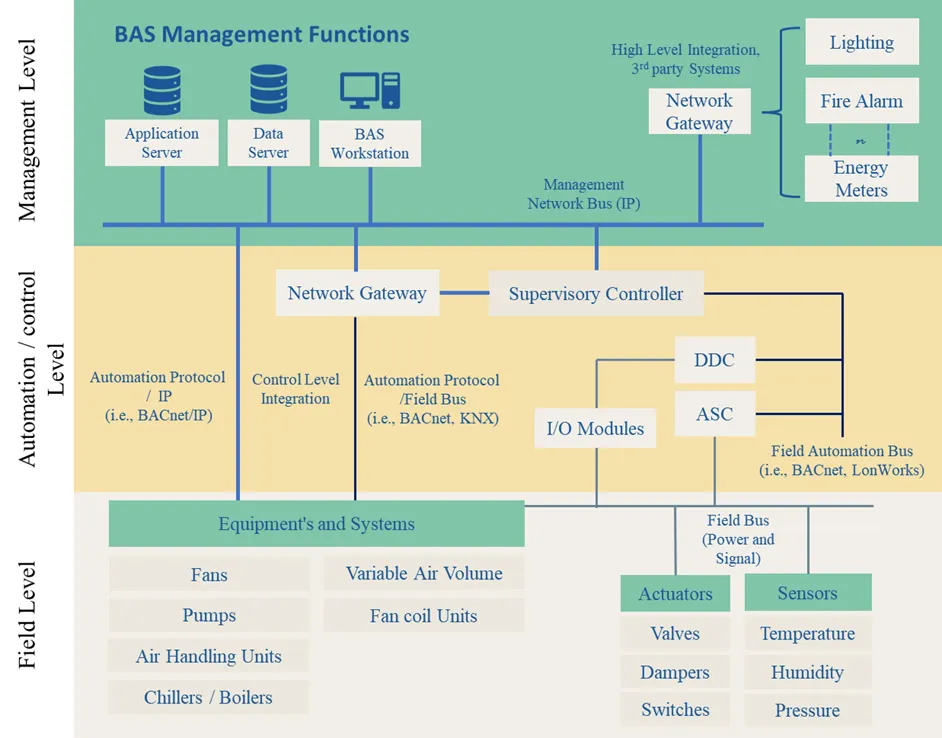
The typical architecture is known to have three layers: the management layer, the control level, and the field devices level.
Management Level
It defines the delivery of information across the architecture. The software part contains the applications that process the presented Data for further monitoring and operation control, in addition to the high-level interface with other systems within the building. The hardware part allows for data storage and processing capabilities.
Automation/Control Level
This level allows for the processing functions, consisting of Supervisory Controllers, Direct Digital Controllers (DDC), and Application Specific Controllers (ASC), depending on the complexity of the operations to be carried out, with the capacity to process and perform field control logics. It allows mid-level integration with third-party system panels and, where required, via automation protocol gateways and routers. It passes further the collected data to the management level, acting as an enabler for the field devices.
Field Device Level
This level comprises the field sensors and actuators. Known as the low hardware level, it represents the physical components responsible for collecting the data, i.e., pressure, temperature, velocity, and humidity. Also, the control components perform functions like actuating and low-level physical integration with various equipment for further Control and monitoring.
The Communication Protocols
Building Automation Protocols are the standards that make communication possible between different devices and between the field and the control levels and are used as part of the building automation systems. The communication protocols can be open or proprietary.
Open Protocols
Open communication protocols are independent of any hardware or software. The rules are publicly available and suitable for many BAS applications. Open protocols allow for integrating devices from multiple manufacturers into building automation systems. It also provides Interoperability of system components like sensors, controllers, and actuators. One of the popular protocols used by BAS manufacturers is the BACnet protocol which complies with the ISO 16484-5 global standard. If we compare the most common open protocols, including BACnet, LonWorks, Dali, KNX, Zigbee, and Enochen, we would conclude that no single protocol is enough for the whole building to operate as every protocol has some limitations. However, it is widely known that BACnet is above the other protocols in terms of Security and Scalability.
Proprietary Protocols
The data structure of a device using proprietary protocols is not shared by its manufacturer, making the System locked to be interfaced with other systems or subsystems. There are many drawbacks of going with proprietary protocols, including compatibility to integrate with third-party systems to extend a limited functionality, it ties up the building owner to a particular vendor for the life of the installed System and its devices, and it limits the scope to scale up or upgrade the System as more requirements evolve.
The BAS Standards
Many standards rule the structure and work around Building Automation Systems. One of the primary standards developed by ISO is the ISO 16484 family. Another one is the ISO 52120-1:2021: "Energy performance of buildings - Contribution of building automation, controls, and building management, General Framework and procedures". There are also various bodies that provide certifications of compliance with BAS standards, directives, and regulations, like the BTL (BACnet Testing Laboratories). Another example is the eu.bac, the European Building Automation Controls Association provides certification for BAS products indicating they fulfill assured levels of energy-efficient performance and quality assurance.
The Modern BAS Architecture
The modern intelligent and smart building involves installing and using advanced and integrated building technology systems like BAS, life safety, telecommunication, facility management, and other user-based digital systems. According to the Directorate-General for Energy of the European Commission, "The 'smartness' of a building refers to its ability to sense, interpret, communicate and actively respond in an efficient manner to changing conditions concerning the operation of technical building systems, the external environment (including energy grids) demands from building occupants."
My takeaway behind the smartness of the building is to achieve what I call the golden rules: occupant comfort and security, operational efficiency, and reduced energy consumption. In other words, increasing comfort while reducing costs.
The emerging technologies that we know about from AI to IoT, cloud computing, and Digital Twin have added to the functionality of the BAS contributing to the smartness of buildings.
Artificial Intelligence and Machine Learning
AI applications offer for building operational efficiency and energy management the possibility of improved system control and the generated data from the building can be used by AI applications to improve in addition to operational efficiency, emission, and user comfort, and support advanced FDD enhancing maintenance works.
Internet of Things (IoT)
IoT is another technology that adds value to the BAS system. Bringing the data from the edge to the cloud unlocks further applications to analyze and incorporate the results with BAS dashboards or training AI/ML models that contribute to the BAS's operational functionality. IoT-powered BAS would add value to occupant health and comfort by monitoring indoor air quality to data insights by allowing vast amounts of data collection beyond the capacity of the BAS system.
Cloud Services and Cloud Computing
We can use cloud technology to manage and operate buildings more efficiently. We can utilize more computing and storage to enable technologies like AI and machine learning services as part of the BAS. We can use it to deploy web applications as an extension to the Building Automation system to analyze collected data, make informed decisions, allow remote Control, and understand the occupants' behavior.
Digital Twin
The Digital Twin provides three-dimensional visualization of the building operation and occupancy. It can be used for predictive maintenance to predict when building systems are likely to fail and to optimize energy by monitoring the usage of energy systems in a virtual space. Having the DT part of the BAS increases the potential for improved energy efficiency, security, and comfort.
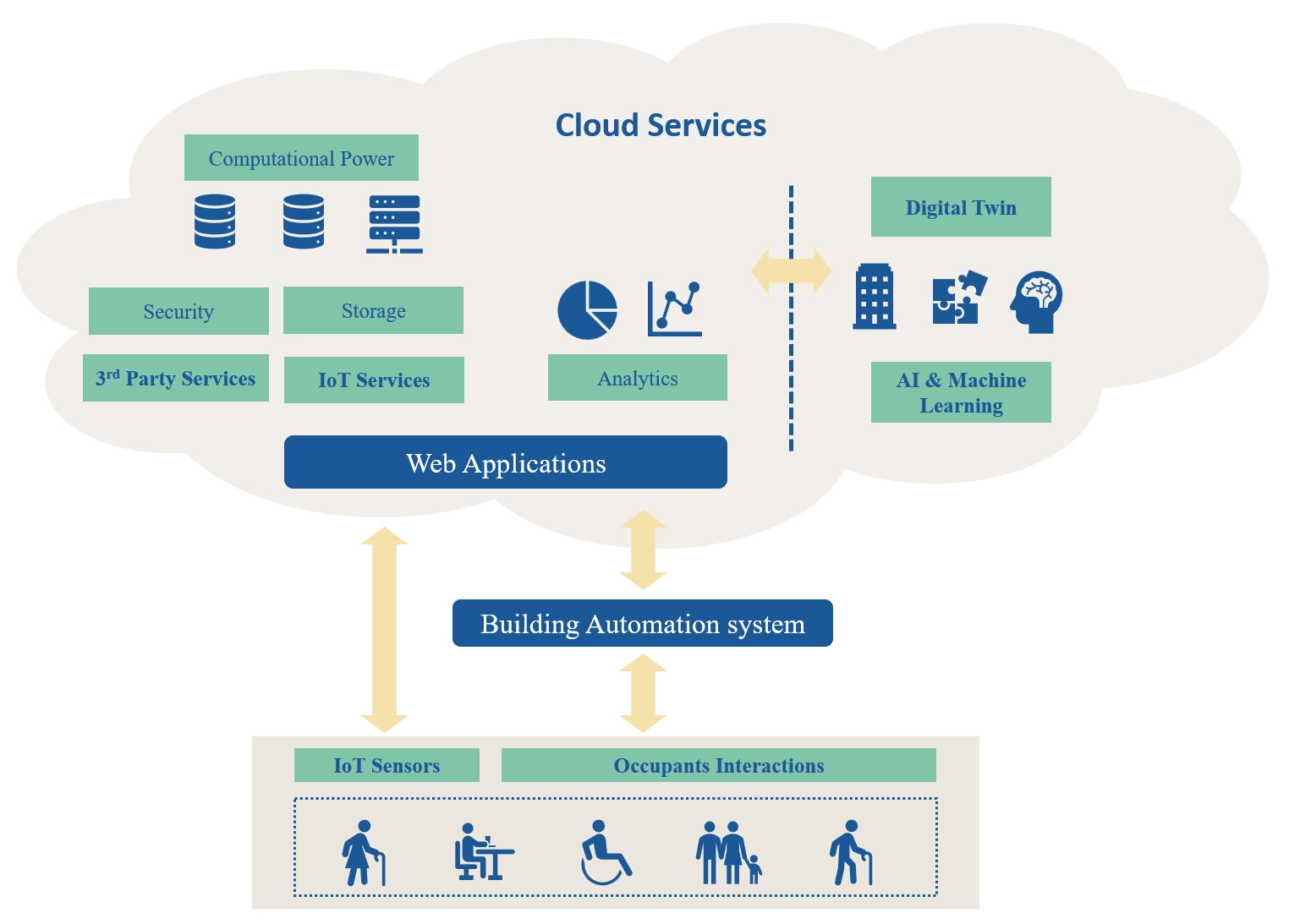
The modern BAS architecture would extend the traditional typical levels into newly added layers that extend its functionality and achieve the set objectives of comfort, operational efficiency, and reducing energy consumption. The typical BAS system is now part of a larger integrated service within a building.
Challenges
This modern BAS architecture for intelligent buildings and built spaces comes with many challenges:
Interoperability
Interoperability is a critical factor in making the whole architecture work. It addresses among the necessary layers the technical challenges of helping set up the required information systems environment to allow a steady flow of data and ensuring the use of common descriptions of exchanged data (Data Semantics). While some companies advertise their System as using an open protocol, an open protocol does not mean it is open itself.
Privacy Concern
The availability of private data generated by various sensors, whether interacting directly with the user or due to the trend and performance of the occupied spaces, opens up individuals' personal information. Privacy in modern environments must be addressed to guarantee the widespread adoption of modern technologies.
Big Data
As more applications are added to the BAS, more Data is collected due to more data points under the BAS management. It poses a significant challenge dealing with big data, its management, and the security and privacy of intelligent buildings' data collected and generated.
Security
According to the NIST Framework for Cyber-Physical Systems (CPS), producing trustworthy intelligent buildings requires that attention be given to the five design considerations: safety, privacy, resilience, reliability, and cybersecurity. These considerations should be studied in a cross-section holistic manner at various levels of components.
Dynamic Thermal Comfort
The occupants are supposed to become experts in the latest technologies used in the building and how to operate them to achieve an energy-efficient building space, which can challenge their daily habits.
Financial Resources Management
Many studies highlighted the high costs of implementation and maintenance of smart building technologies or spending financial resources on intelligent building solutions or technology without a clear strategy or benefit.
The BAS architecture will undergo further modifications as we move towards the future and more technologies are adopted that would add value addressing the golden rules I stated: increasing comfort and reducing costs. Until then, we continue to innovate to elevate our lives and the generations to come.
Notes:
Many standards under development would rule and affect the usage of new technologies especially in the built space, like the ISO/DIS 37173, "the Development guidelines for the information system of smart buildings and smart community infrastructure", and the standards related to Artificial Intelligence (ISO/IEC 22989), AI quality (ISO/IEC 5059), and AI Development risk management (ISO/IEC 23894).
Thank you for being here and reading this piece.